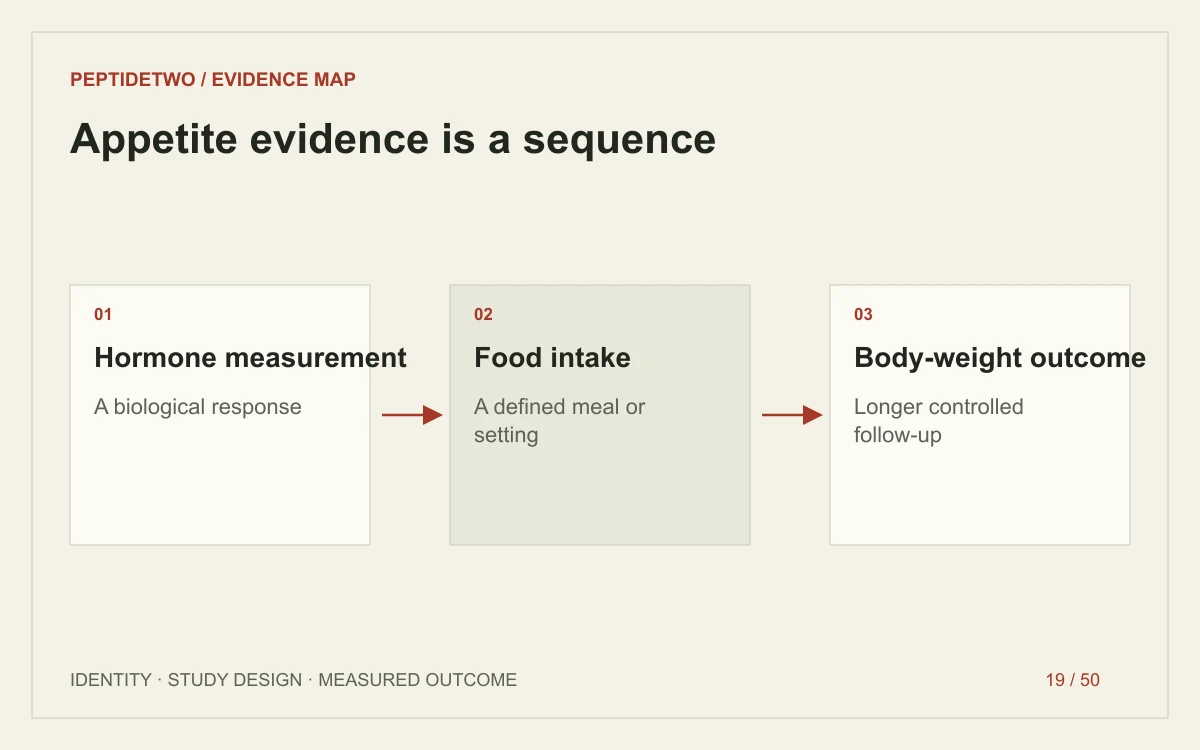
Collagen for weight loss is a broader claim than the small appetite experiments usually cited. A change in a gut hormone, a laboratory meal or a short-term appetite rating does not by itself demonstrate sustained weight loss. It also does not make collagen a substitute for a GLP-1 receptor agonist medicine.
The appetite experiments do not all report the same result
A small crossover pilot study compared acute whey and hydrolysed-collagen exposure in ten healthy women. It did not find a difference in the measured appetite perceptions or food consumption between those conditions, despite a difference in leptin.
A later randomized post-exercise study in physically active females reported lower intake at a subsequent meal and changes in some hormone measurements with the studied collagen preparation. The setting, comparator and duration differed. These are research observations, not interchangeable predictions of everyday calorie intake.
Why a GLP-1 measurement is not a GLP-1 medicine
Endogenous hormone concentrations can change after eating. That is a different intervention from exposure to a receptor agonist with a defined pharmacological profile. Health Canada’s peptide overview distinguishes established peptide medicines from other peptide products.
Scroll horizontally to read all columns.
| Finding | What it may support | What it does not establish |
|---|---|---|
| A hormone level changes | A biological response to an intervention | Equivalence to a receptor-agonist medicine |
| One meal’s intake changes | A short-term behavioural outcome | Sustained weight change |
| Subjective appetite changes | A reported experience in that setting | A universal response |
| Long-term weight changes | A directly measured weight outcome | Benefit for every formulation or person |
Keep exercise and the comparator in the explanation
A post-exercise experiment cannot automatically predict what occurs on a sedentary day or in a different population. A comparison with a non-protein placebo also asks a different question from a comparison with another protein. The complete methods determine which contrast is meaningful.
Likewise, muscle-protein-synthesis research concerns another endpoint. It cannot supply a missing weight-loss outcome. Dietary protein, muscle synthesis, appetite and body-weight change should not be merged into one unsupported “fat burning” claim.
What evidence would answer the weight question?
A useful weight-loss trial would specify the preparation and comparator, run long enough to assess body-weight change, account for the rest of the diet and report participant retention and adverse events. Prespecified outcomes and a transparent analysis would help distinguish a reproducible effect from a selected result.
A short biomarker study can motivate that trial. It cannot replace it. Our endpoint guide explains why the endpoint must match the promise.
How to read a product claim
Ask whether the claim is about protein content, appetite, weight or a diagnosed condition. Identify the exact evidence for that claim. A reference to natural GLP-1 release is insufficient to call a food-derived ingredient a medicine or to infer the effects of semaglutide.
Read collagen versus whey for the protein comparison and the food-noise evidence guide for appetite terminology. This article does not prescribe a diet, select a medicine or recommend a weight-loss regimen.