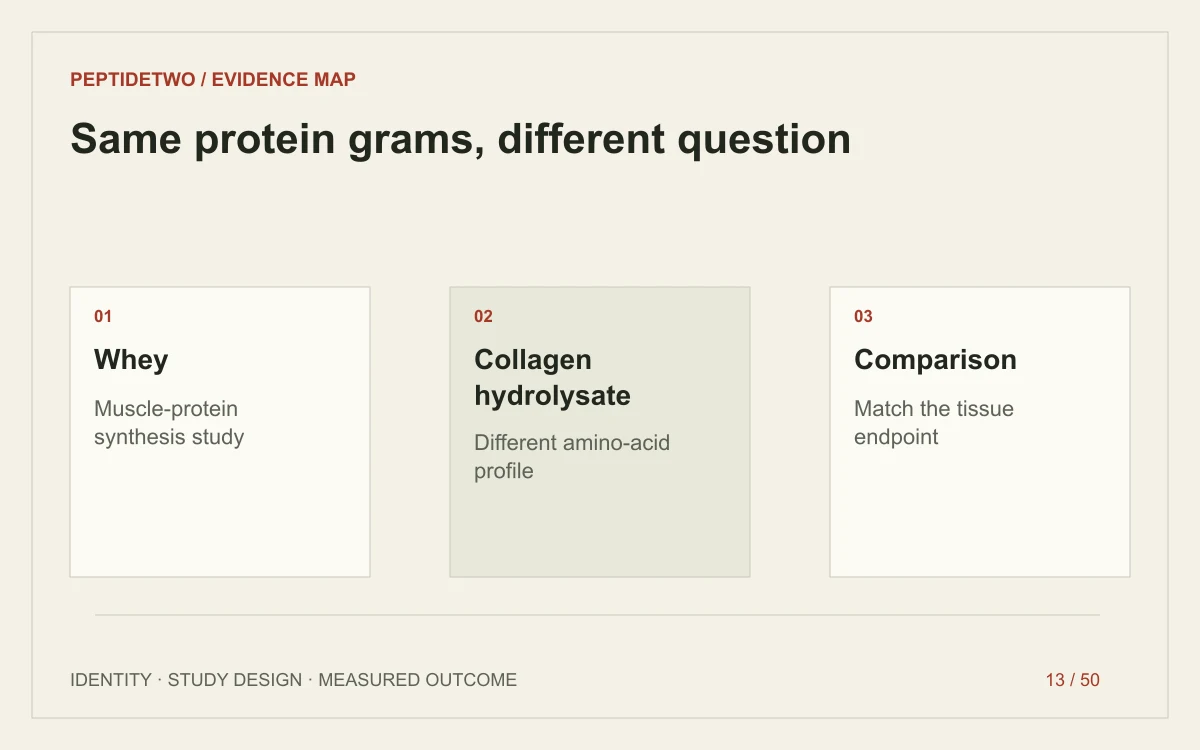
Collagen peptides vs whey protein is not settled by counting grams of powder. Protein sources differ in amino-acid composition, and a study of muscle-protein synthesis answers a different question from a study of skin elasticity or tendon-related biomarkers. Start with the tissue and outcome rather than assuming one powder is best for everything.
What the direct muscle-synthesis comparison found
Oikawa and colleagues’ randomized trial compared whey and collagen peptides in healthy older women, with and without resistance exercise. Whey produced greater increases in the measured acute and longer-term muscle-protein-synthesis responses. The study supports a comparison in that experimental setting, rather than a universal ranking for every tissue or population.
Muscle-protein synthesis is a measured biological process. It should not be rewritten as an exact prediction of visible muscle gain, strength or performance for every person. Those outcomes require their own trial designs and follow-up.
Different outcomes require different comparisons
Scroll horizontally to read all columns.
| Research question | Relevant outcome | Why the distinction matters |
|---|---|---|
| Muscle protein response | Tracer-measured synthesis | Does not directly measure skin changes |
| Strength or muscle size | Performance and body-composition outcomes | Requires a training and follow-up context |
| Connective-tissue biology | Specified tissue or biomarker | Does not automatically establish injury healing |
| Skin appearance | A defined cosmetic endpoint | Cannot be inferred from total protein intake alone |
Two products can both contribute dietary protein while being unsuitable substitutes for the same research hypothesis. Their ingredient profiles and the rest of the diet still matter.
Why collagen studies cannot be used as whey studies
The gelatin-and-exercise study explored a collagen-related biomarker question. It did not demonstrate that gelatin outperformed whey for long-term muscle growth. Similarly, detecting collagen-derived peptides in human blood demonstrates exposure, not superiority for all outcomes.
A product page may cite both types of work beneath a “recovery” headline. That umbrella word is not a clinical endpoint. Ask whether recovery means soreness, strength restoration, tissue synthesis, a return to activity or a patient-reported symptom.
Look beyond a serving-size comparison
A label can state grams of protein without describing amino-acid distribution or proving a clinical effect. Flavours, additional nutrients and serving sizes can also differ between products. If a trial tests a specific ingredient specification, a similarly named retail blend may not be the same intervention.
For a scientific comparison, record the intervention amount as a study detail, the comparator, the participants and the measured outcome. Do not convert that report into a personal intake recommendation. This article does not select a dietary regimen.
How to use the evidence without overclaiming
The direct trial is useful when discussing muscle synthesis in older women. It cannot settle every question about younger athletes, injury care, skin or long-term function. A fair article states both what the study supports and what remains unmeasured.
Read collagen skin outcomes for a different endpoint and the wider muscle-growth evidence guide for how research peptides differ from dietary proteins. These categories share terminology without sharing every biological or clinical claim.