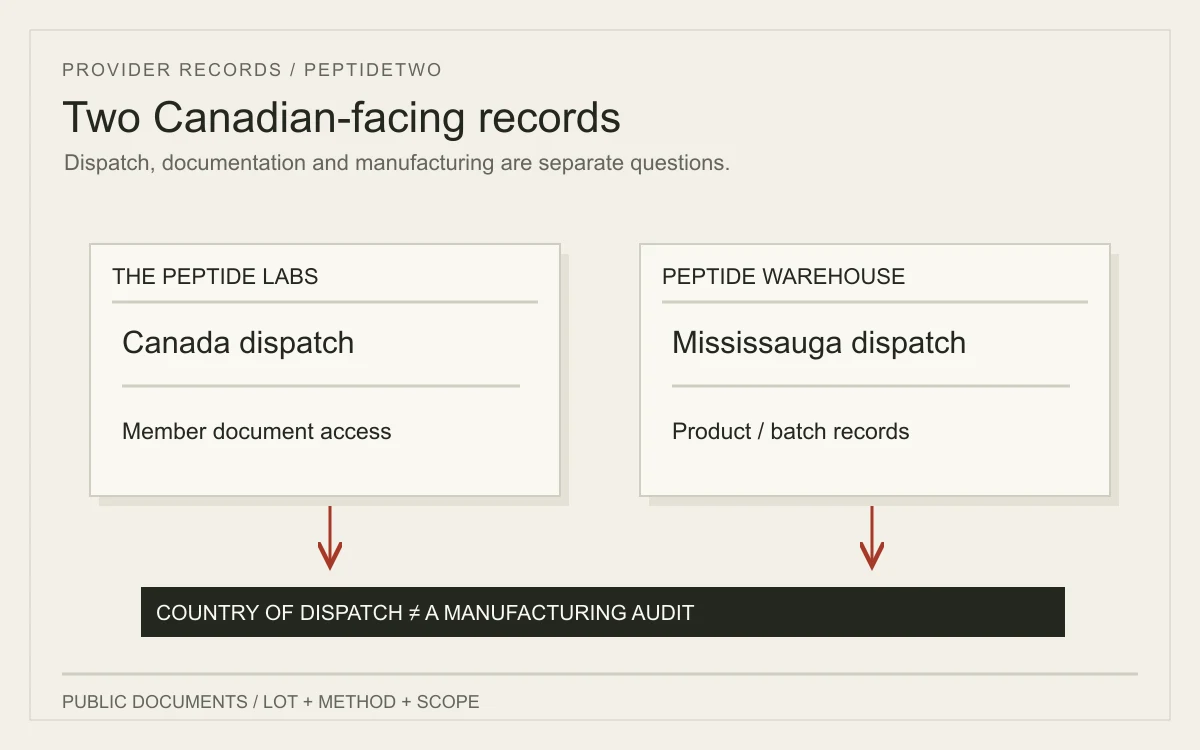
The Peptide Labs and Peptide Warehouse both publish Canadian-facing research-supply information. The useful comparison is specific: how can the relevant lot documents be reviewed, what does the product record actually describe, and which shipping conditions apply to the research destination? A Canadian address or flag alone does not answer those questions.
For The Peptide Labs vs Peptide Warehouse, this review uses each company’s own pages as evidence of its published statements. It does not turn manufacturing or testing claims into independently verified findings.
Review scope: Public website information checked on November 6, 2026. This is a documentation comparison, not an independent product test, transaction test or endorsement. No affiliate links or paid placements were used in this series.
The Peptide Labs vs Peptide Warehouse: public records
Scroll horizontally to read all columns.
| Review field | The Peptide Labs | Peptide Warehouse |
|---|---|---|
| Canadian service context | Company page describes Canadian research supply and Canadian dispatch | Homepage and shipping policy describe Canadian service |
| Document access | Company page describes member-only certificates | Research FAQ directs readers to product- or batch-linked certificates when provided |
| Dispatch information | FAQ explains payment and business-day processing conditions | Shipping policy identifies a Mississauga warehouse and business-day conditions |
| Product comparison | Read the exact identity and nominal amount in the selected record | Read the exact identity, blend components and available format |
| Manufacturing conclusion | Not independently audited here | Not independently audited here |
Canadian dispatch is a logistics fact, not a manufacturing audit
The The Peptide Labs company page says orders are dispatched from within Canada. Peptide Warehouse’s policy identifies dispatch from Mississauga. These statements help describe the published logistics model. They do not establish where every synthesis, purification, analytical test or packaging step occurred.
Peptide Warehouse’s homepage also makes Canadian-manufacturing claims. The appropriate follow-up is to identify which operation and facility each claim concerns. A public country-of-origin statement and a facility audit are different evidence types. The same standard should apply to either provider when a manufacturing-origin question matters.
Compare access to a specific report
The Peptide Labs’ company page describes certificates as member-only. Its relevant question is whether a qualified researcher can review the matching report before relying on it, and how membership affects that process. This review did not create an account or retrieve private documents.
Peptide Warehouse’s public FAQ says product listings may include certificates and instructs readers to inspect the certificate for the specific product or batch. The word “may” matters: it does not establish that every current product or lot has the same publicly accessible report. Record what is actually available for the material being evaluated.
For both companies, use the provider COA comparison guide. Check the lot, report date, laboratory, method and result. A report for a similarly named material or earlier batch should remain a separate record.
Normalize the product description before comparing cost
Compare a single compound with the same compound and molecular form. For a blend, retain all named components and each declared amount. A total blend mass does not specify the amount of every constituent. Also distinguish nominal label quantity from an independently measured content result.
For a practical record, use separate columns for identity, form, declared mass, number of containers and supporting assay information. The purity and content guide explains why a chromatographic percentage cannot fill the content column automatically.
Read the shipping policies in full
The The Peptide Labs FAQ describes Canadian-address restrictions unless otherwise stated, processing conditions and carrier information. Peptide Warehouse publishes its own dispatch, destination and delayed-parcel conditions. A checkout destination and current written policy are more useful than assuming the same rule from a shared national market.
Record payment cut-off time with its time zone, business-day exclusions and the distinction between dispatch and transit. Promotional shipping thresholds can change and may use different tax or discount bases. We did not complete transactions or time deliveries, so the article does not declare a faster or cheaper company.
Research scope and the decision record
Peptide Warehouse’s terms describe laboratory, industrial and research purposes and exclude administration to humans or animals. Keep a provider comparison within its stated research context. A catalogue entry is not an individual treatment recommendation or a substitute for an authorization record.
The practical outcome is a short list of resolved and unresolved fields for each company. If the relevant report, identity or destination policy is unclear, retain that gap instead of inventing a score. The US and Canadian provider guide extends the same method across markets, while the ten-website overview provides other documentation models to compare.
Examine access, origin and analytical scope separately
The The Peptide Labs certificate guide distinguishes a public testing statement from an inspected member report. The Peptide Warehouse Canada documentation review separates manufacturing stages, dispatch and lot records. For a different material comparison, BioTech Peptides versus The Peptide Labs focuses on single components, blends and measured content.