An impurity profile describes what a set of analytical methods detected and characterized in a sample. It is not an inventory of everything that could be present. A minor chromatographic peak may be real while its identity remains unknown; an expected peptide mass may be present while other components remain unresolved. Reading the profile well means distinguishing a detected signal, an assigned structure and a quantified amount.
Peptide impurity profile: separate possible sources
Peptide-related impurities may include altered sequences, deletion or addition products, modified residues, or degradation products. Other components can arise from reagents, counterions, solvents, or the surrounding formulation. The actual possibilities depend on the manufacturing and storage context; a generic list is not proof that a specific lot contains them. A useful report distinguishes observed signals from hypothetical pathways and identifies what was tested. The ICH Q6B guideline discusses purity, product-related substances, impurities, and contaminants for biological products, offering a disciplined vocabulary within its regulatory scope.
Understand an unknown peak
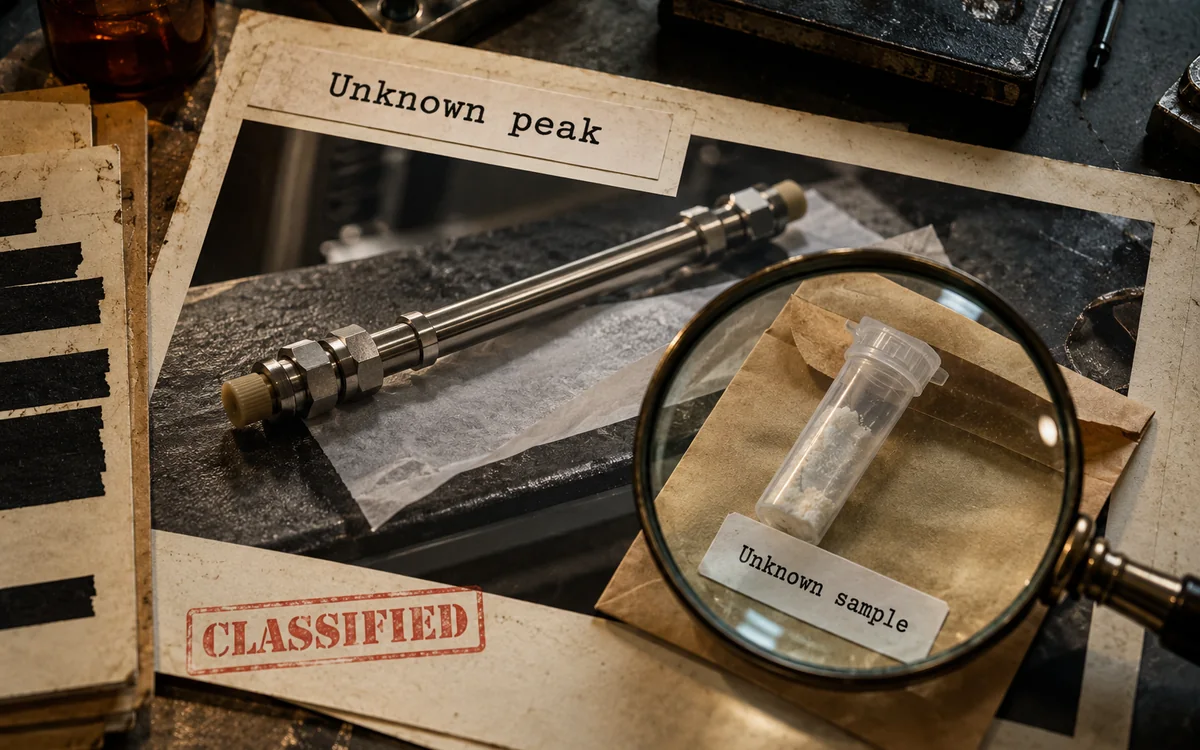
A chromatographic peak means the detector responded at a retention time under specified conditions. It does not reveal a complete chemical structure by itself. Co-elution, detector response differences, and integration thresholds can obscure interpretation. An unknown peak may need another separation, mass-spectrometric evidence, a reference material, or other orthogonal work. The MS identity guide explains why an intact-mass match is useful but may not settle every structural alternative.
Ask whether the method can see what matters
Selectivity, accuracy, precision, detection capability, and reportable range depend on the intended question and sample matrix. An assay optimized for main-peptide content may not be suitable for trace impurities. ICH Q2(R2) provides a framework for matching validation characteristics to use. The FDA analytical-method guidance also emphasizes method description and reporting. If the analytical scope is unclear, do not interpret “no peak observed” as proof of absence.
Keep purity, content, and impurity identity distinct
A large main HPLC area percentage may coexist with an uncertain amount of target peptide or an uncharacterized minor component. The calculation may exclude undetected materials. Conversely, a low-level extra peak may not have a known identity or significance until further work is done. Our purity-versus-content guide explains the arithmetic. A COA should show the method, criterion, and result that support each distinct claim.
Follow an unknown signal through three separate questions
The first question is whether the signal is reproducible and distinguishable from background, carryover or a processing artifact. The second is whether it can be assigned to a chemical species. The third is whether an appropriate method can quantify that species on a stated basis. A peak can answer the first question while leaving the others open.
The cited atosiban impurity study illustrates complementary characterization: tandem mass spectrometry supported a structural modification, and another analytical approach provided confirmation. The lesson is about matching methods to the unresolved structure. It does not imply that every unknown peptide peak can be assigned from a retention time or a routine intact-mass measurement.
Process-related and degradation-related are hypotheses to investigate
A component associated with synthesis and one formed during later change can lead to different investigations. To distinguish them, the record may need manufacturing context, time-related observations and structural evidence. A label such as degradation peak should not be assigned solely because the peak is inconvenient or appears in an older sample.
A new peak after a method change can also reflect improved resolution rather than newly formed material. Comparing the old and new separations is therefore part of the investigation. The stability article explains why a time-series claim needs compatible methods and a clearly defined sample system.
An impurity percentage needs its own measurement basis
An area percentage is a fraction of included detector responses. It may not be the mass fraction of the assigned impurity, particularly when response factors differ. A quantitative conclusion needs the method, calibration or justified response assumptions and reporting basis. The unknown component’s area cannot automatically be converted into a measured mass.
The detection limit is another boundary. No detected peak means the method did not detect a qualifying signal under the conditions used. It does not mean that every possible impurity is absent. A component outside the method’s scope can remain invisible, and an unresolved component can remain within a main peak.
For research peptides offered online, a single high purity number therefore leaves a different question from an impurity-characterization report. Ask which methods examined relevant alternatives and which peaks were left unassigned. A bounded statement about observed signals is more useful than an absolute claim of chemical cleanliness that the method cannot support.
Report the finding at the right level
A careful statement identifies the sample and lot, analytical conditions, observed peak or impurity measure, detection or quantitation limit where relevant, and uncertainty. If a peak is unassigned, call it unassigned. If the method cannot distinguish isomers or co-eluting products, say so. When comparing lots, use comparable methods and consider whether sample age or handling differs. That wording is more useful for research than a confident but untraceable “clean” label.
An unassigned minor peak
Imagine a chromatogram with a small additional peak next to the assigned main peptide. The first defensible statement is that an extra detector response was observed under the reported conditions. It might be a process-related component, a degradation product, a sample-preparation artifact, or another species; retention time alone does not decide. Review system suitability, blank, repeat measurement, separation, and any mass or reference evidence. If the method has not quantified that peak reliably, avoid attaching a confident amount. “Unknown” is a useful analytical status when it is paired with a clear plan for characterization rather than hidden from the report.
A primary example of impurity characterization
A published investigation of a synthetic peptide impurity used complementary mass-spectrometric approaches to characterize a particular component. Its methods and conclusion apply to that studied material, not to every unknown peak on a COA. The example shows why an assignment requires more evidence than a chromatographic retention time and why an unassigned peak should remain explicitly unassigned until appropriate characterization is available.
Check the scope of impurity detection
- Which components were detectable under the stated analytical method?
- Was an unknown peak identified, quantified, or merely observed?
- Are the purity and content statements based on separate validated measurements?
Questions about unassigned components
Does an unknown HPLC peak identify an impurity?
It shows a detector response under particular conditions. Without further evidence, the component’s structure and origin remain unknown. Blank runs, repeat measurements, orthogonal separation, mass data, and reference materials can help narrow possibilities. The report should not assign a chemical name based on retention time alone.
Does “no impurity detected” mean none exists?
It means no relevant signal was reported above the method’s limits under the stated conditions. A method cannot exclude components it does not detect, separate, or quantify. Read the detection capability, sample matrix, and impurity scope before interpreting an absence statement.
Why distinguish degradation from process-related material?
They suggest different questions about source and change over time. An observed component may arise during production, storage, or sample preparation, and one chromatogram may not reveal which. Linking impurity observations to stability data and lot history can make the interpretation more informative without assuming a cause.